

Skill Activation Timing in Arknights: Endfield Battles
 February 3, 2026February 3, 2026
Skill Activation Timing in Arknights: Endfield Battles
In the strategic battles of Arknights: Endfield, the proper sequence and timing of skill deployment are crucial to determining victory or defeat. Not only does this maximize damage output, but it is also key to overcoming high-pressure stages, elite enemies, and bosses. Mastering the timing means seizing the initiative in battle.
Basic Rotation: Skill Sequence and Buff Stacking
A smooth skill rotation is the cornerstone of damage output. Taking a classic physical team combo as an example, its core concept is to sequentially stack buff states through skill order, ultimately triggering explosive damage.
The specific operation is as follows: first, deploy Ember to absorb an attack and trigger her linked skill (note that other linked skills should not be activated at this time). Then switch to the Endministrator (main controller) and immediately activate Lifeng's combat skill, which applies the Physical Vulnerability effect (pay attention to potential requirements). Next, activate Chen Qianyu's linked skill to stack defense break layers. After that, use the Endministrator's normal attack heavy strike to trigger Lifeng's linked skill, applying the "Combo" buff to the target. Then follow up with the Endministrator's linked skill to add the "Originium Crystal" status. Finally, activate the Endministrator's combat skill; this strike consumes all previously stacked buffs to deal explosive damage.
During routine map clearing and miscellaneous tasks, the rotation can be simplified as follows: start with Lifeng's skill, followed by Chen Qianyu's linked skill, then trigger Endministrator's heavy attack to activate the linked skill, proceed with Lifeng's linked skill, and finish with Endministrator's skill or ultimate. The order of Endministrator's and Lifeng's linked skills can be interchanged, but it is crucial to ensure that Endministrator's primary damage skill is used after Lifeng's linked skill grants the "Combo" buff.
Boss Battles and High-Pressure Response: Interruptions, Damage Mitigation, and Burst Windows
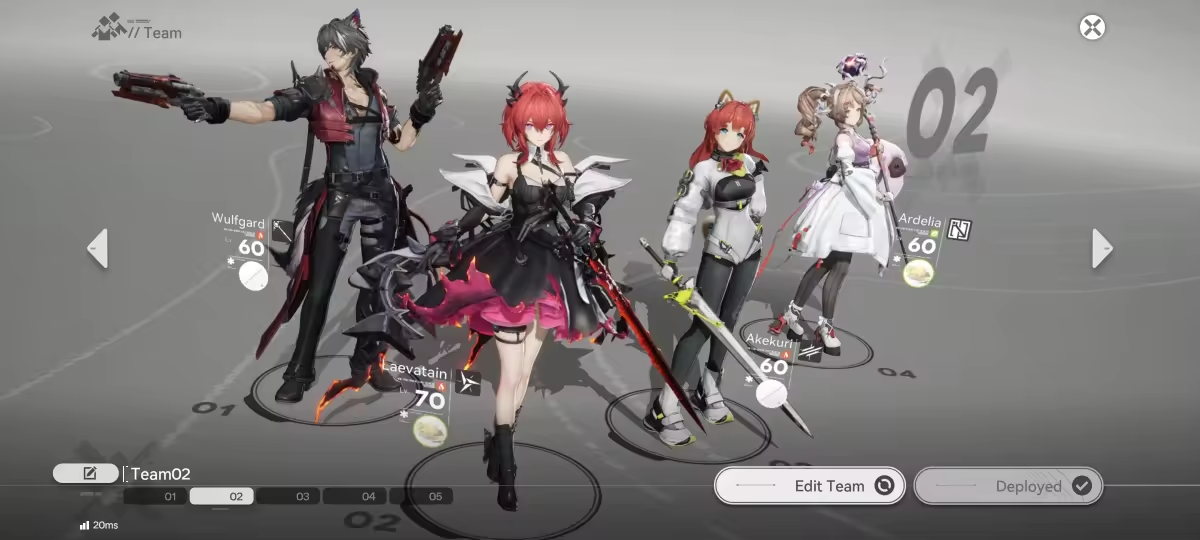
When facing elite enemies or bosses with long skill startup times and high damage, strategic timing of skills becomes even more crucial. For example, during the startup phase of a Wulfgard's skill, activating Snowshine's combat skill can provide damage reduction for your team, effectively easing survival pressure. This indirectly lowers the required level of training needed to clear the stage.
For bosses with super armor shields, the battle is divided into two phases: shield breaking and damage output. In the early stage, focus fire or use specific skills to deplete the super armor gauge. Only after the super armor gauge is fully depleted can additional control effects or vulnerability states be applied. This is the perfect window for a full burst. Therefore, ultimate skills (finishing moves) must be reserved for this moment and released only when damage-increasing buffs such as "Physical Knock Down," "Magic Vulnerability," or "Ice Shatter" are active, to achieve double damage.
When dealing with groups of minor enemies, efficiency is equally important. You can use Laevatain's combat skill to gather them, then employ Estella's combo skill for area clearing, thereby conserving ultimate resources in preparation for the BOSS battle.
Elemental Reactions and Status Triggers: The Art of Timing in the Spell System
For spellcasting teams, the timing of skill activation is directly linked to triggering elemental reactions, which is an advanced technique for maximizing output. The game features two core mechanics: "Spell Burst" and "Spell Anomaly."
Enhance your gameplay experience! rushbuy.gg provides Arknights: Endfield top-up with low prices!
Spell Burst: Initially, apply one layer of a spell status (e.g., "Heat") as a base. Subsequent applications of the same spell status will trigger a high-damage spell burst and increase the number of spell attachment layers.
Spell Abnormality: Initially applies one layer of a spell status as a base. If a different spell status is subsequently applied (e.g., base is "Heat DMG" and then "Conductive" is applied), abnormal effects such as Heat, Conductive, Frozen, or Corrosion will be triggered. Among these, Corrosion reduces the target's resistance, allowing subsequent physical damage to benefit as well; Frozen provides valuable crowd control time, and when combined with physical abnormalities, can trigger "Shatter" to deal additional damage.
Understanding and anticipating these reaction chains, and activating the corresponding attribute skills at the right moment, is key to dealing massive damage and achieving effective control.
The Impact of Development Timing: Mastery, Potential, and Exclusive Weapons
The depth of character development directly affects the effectiveness and timing of skill deployment. Skill specialization often alters the core mechanics or the feel of the skill cycle, serving as a decisive factor in optimizing output timing. Potential upgrades may reduce skill costs or extend durations, thereby changing the rhythm of skill chaining. Exclusive weapons typically provide powerful attribute bonuses and skill effects, further amplifying the benefits gained from activating skills at the right moment.
Therefore, in resource planning, priority should be given to investing in skill upgrades and mastery for core damage dealers and key support characters, while reserving resources for acquiring their exclusive weapons. A well-developed equipment set, especially with matrix attributes corresponding to the weapon's properties, enables you to deliver damage that exceeds limits at every critical opportunity.