
Arknights: Endfield Pipe Installation Tips How to Lay Pipes Without Clogging
 February 11, 2026February 11, 2026
In Arknights: Endfield, the installation of water pipes differs from other equipment. Players looking to learn how to lay pipes more efficiently can refer to the water pipe installation insights shared by "Ffhhfgh" below. We hope this helps everyone.
The following speeds are measured per second.
Introduction
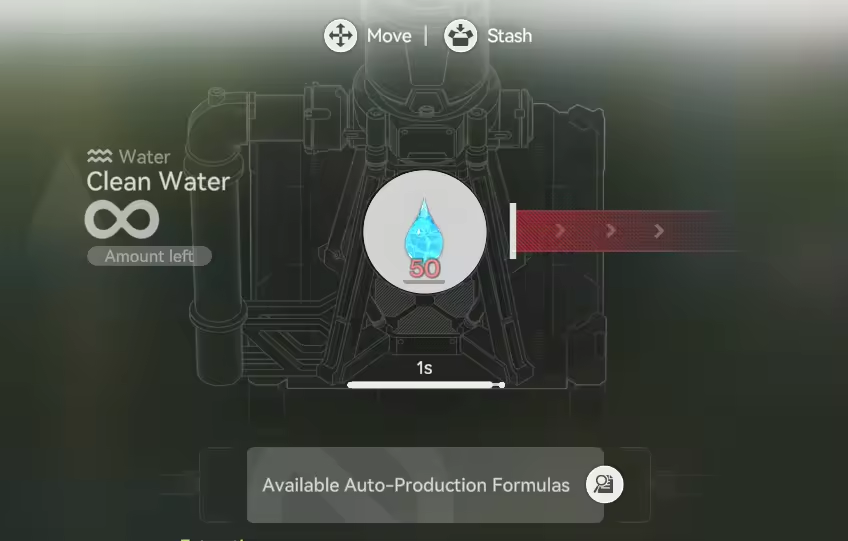
As is well known, the pipe flow rate in Wuling is 2, while the fluid pump's pumping speed is 1. So, will two fluid pumps never get clogged...?
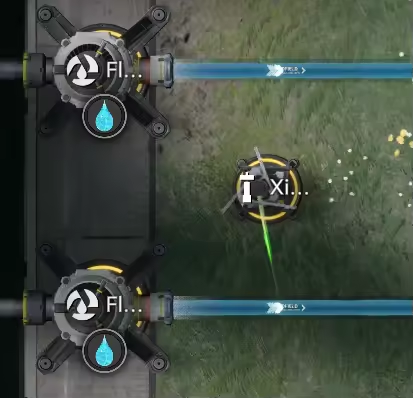
entrance
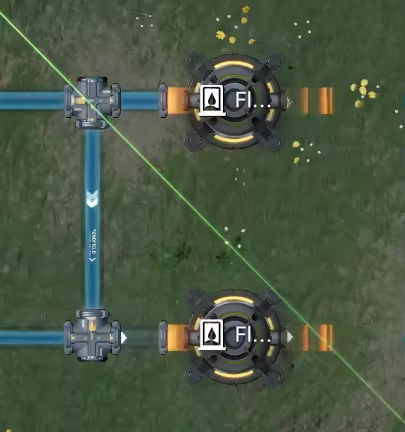
exit
Clogging
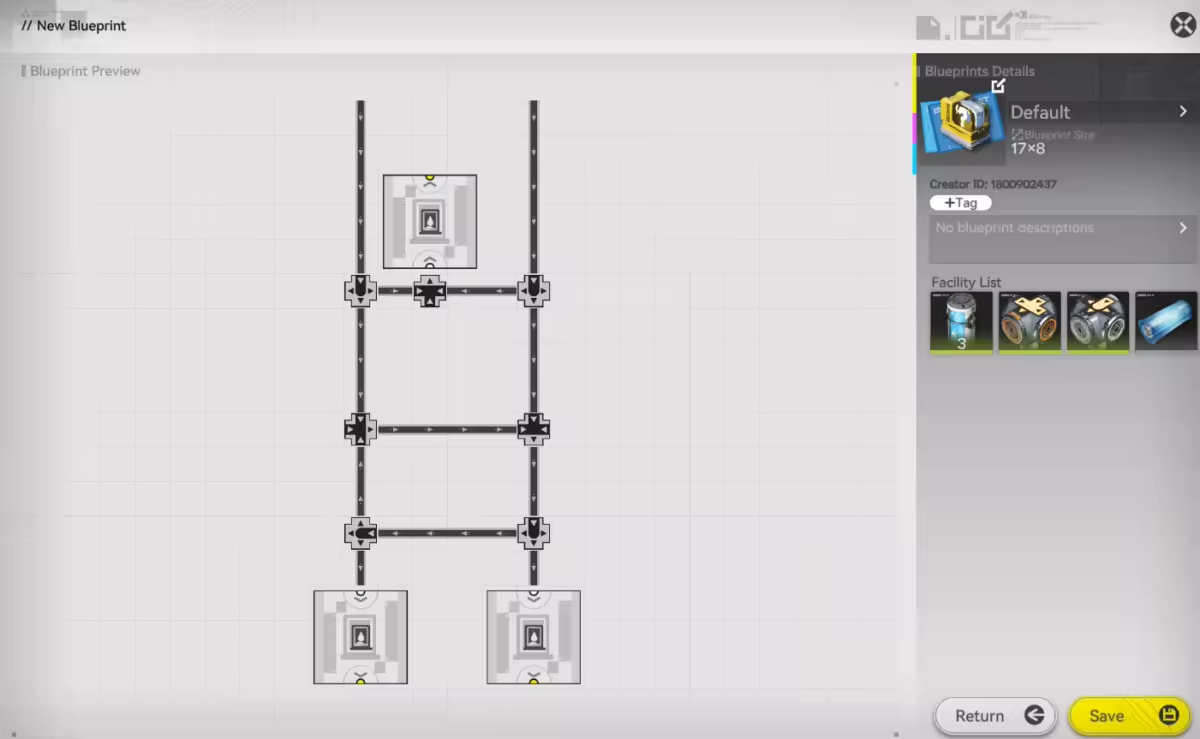
Recirculation Device
The reason is that I set reflux nodes within it, and the water flow in Endfield consists of collision-free particles, so the velocities can be simply summed.
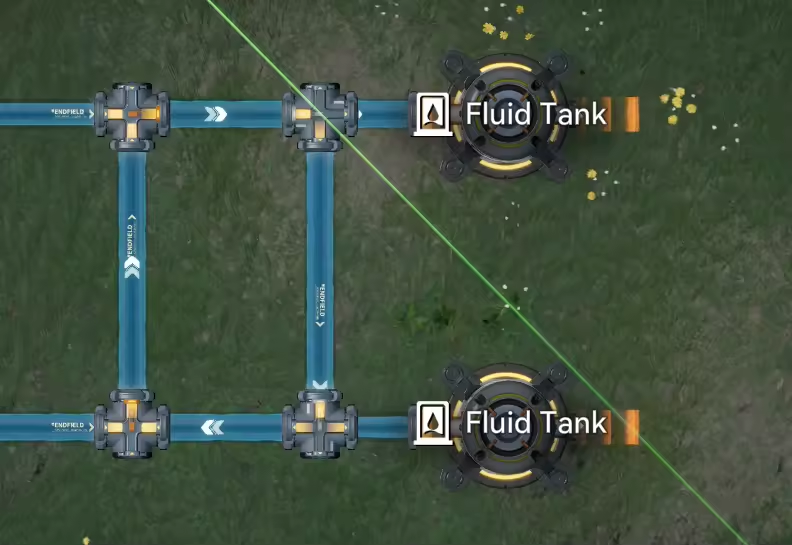
The principle is relatively simple. The conclusion is illustrated with an unappealing diagram, where red indicates one instance of reflux.
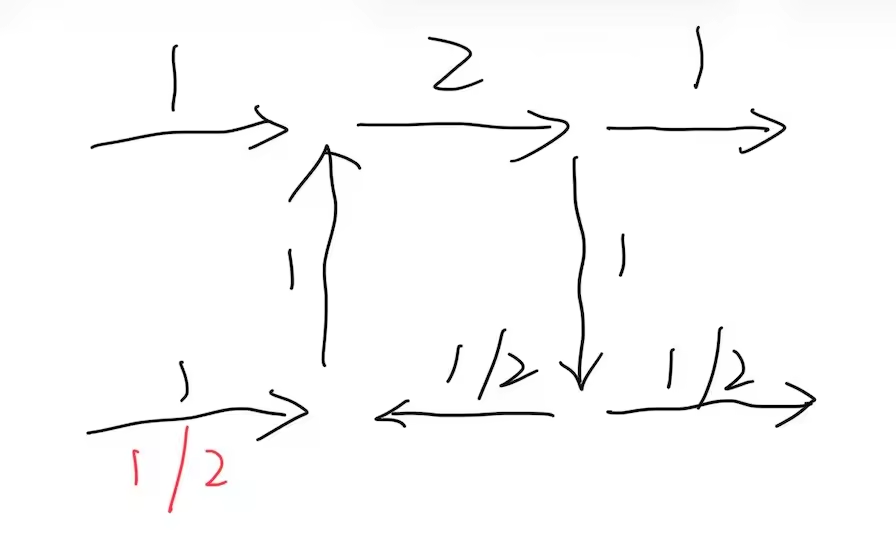
From the image, we can conclude that the main reason for limiting the water flow is the upper pipe, whose flow rate has already reached 2 and cannot be increased further. As a result, after one backflow, the input speed at the lower inlet is reduced to 1/2, causing a blockage.
Application
So what’s the purpose? Is it just to clog the pipes? Actually, when I first researched this, it was to save water. Sometimes, when a blueprint starts up, it uses a lot of water, but after a while, some parts no longer need water (for example, when the Liquid Xiranite tank is full, or some production lines only require powder from a Wuling plant and the Shredding Unit is clogged). So I wanted to design a channel that allows the water flow to increase at other outlets when the flow demand at one outlet decreases. The diagram below shows a basic unit:
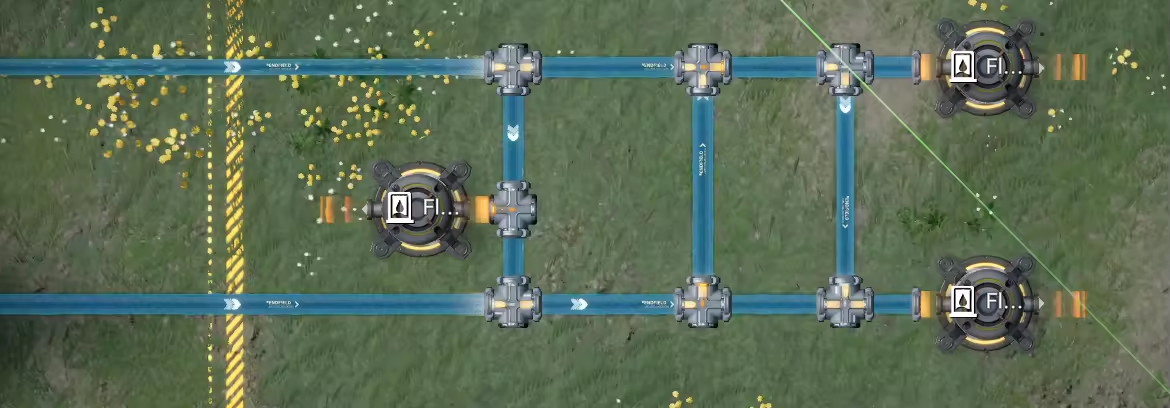
The flow rates of outlets a (left side), b (upper right), and c (lower right) are in the ratio 3:2:1 under normal conditions.
The principle is as follows:
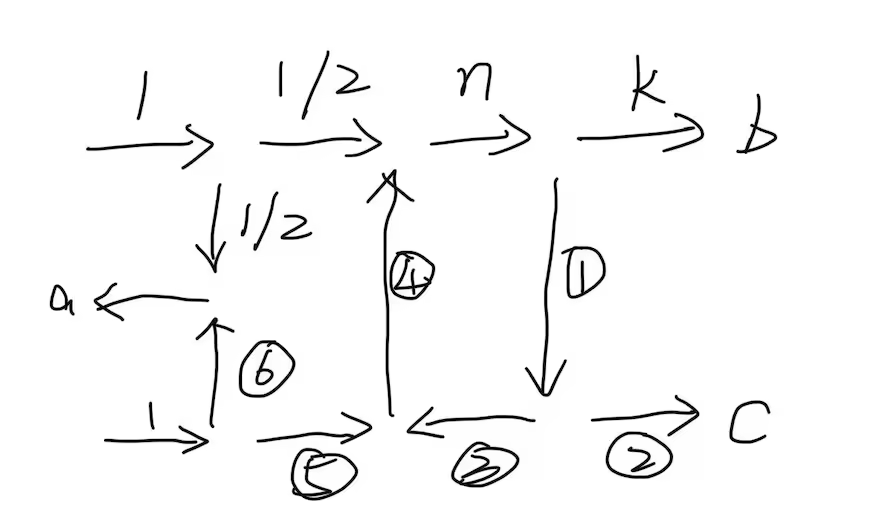
In the first run: ⑥=⑤=1/2, ④=1/2, n=1/2+④=1, k=①=1/2, ②=③=1/4
First reflux, ④ = ③ + ⑤ = 3/4, n = 1/2 + ④ = 5/4, ......
So, what would be the output if it keeps flowing back continuously?
It was observed that output a remains constant at 1, and since ② = ①/2 = k/2, the output terminals b and c have a fixed ratio of 2:1. Therefore, b = (1/3) * 2 = 2/3, and c = 1/3.
Through calculation, we find that blockage is actually a special case of the general scenario. In this reflux device, n limits the output of ports b and c, with a maximum n of 2. When n=2, k=b=1 and c=1/2. At this point, to avoid overall blockage, the outflow rate at port a only needs to be greater than 1/2.
Do you still remember the original purpose? Now, by adjusting the flow rate at port A, we can achieve pressurization at ports B and C. With the initial flow rate at port A set to 1, the initial outputs at ports B and C are 2/3 and 1/3 respectively. After some time, when port A’s flow rate decreases to 1/2, ports B and C can be pressurized to 1 and 1/2 respectively. Thus, we have completed the reflux device pressurizer.
Expansion
As a tri-terminal device, it naturally undergoes an additional expansion: what happens when the water output is restricted at port B?
Envision the final saturated state of the reflux. At this point, due to the restriction of outlet B limiting the outflow, k ≠ ①, where ① = n - k, thus ② = ③ = (n - k) / 2.
Enhance your gameplay experience! rushbuy.gg provides Arknights: Endfield top-up with multiple payment methods!
④ = (n - 1) / 2, ⑤ = ④ - ③ = (n + k - 1) / 2, when n ≤ 2, ⑥ = 1 - ⑤ = (3 - (n + k)) / 2, the water output of a is 2 - (n + k) / 2
There are two situations at this time.
Scenario 1: The pressure at port a is relatively low, and n does not burst, so ⑤=⑥ is always 1/2. At this time, a=1, b=k, and c=1-k.
Scenario 2: When the pressure at point a is high and n fails, n is set to 2. At this point, a < 1/2, b = k, and c = 1 - k/2, causing the pipeline to become blocked. Additionally, when k > 1, it degenerates to b = 1 and c = 1/2. Since this is essentially a water-saving issue, Scenario 2 is rarely used. Interested readers may try it themselves.
Substituting k=1/2 for verification, at this time a=1 and c=1/2, so the ratio a:c=2:1. The verification method uses a planter, with k being constrained.
Due to the presence of water in the non-pipeline section and the varying initial entry times into the storage tank, the ratio is not strictly 2:1, but it has been basically validated.
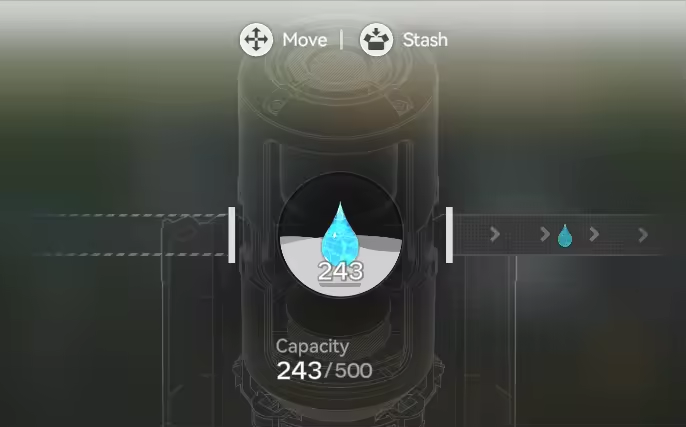
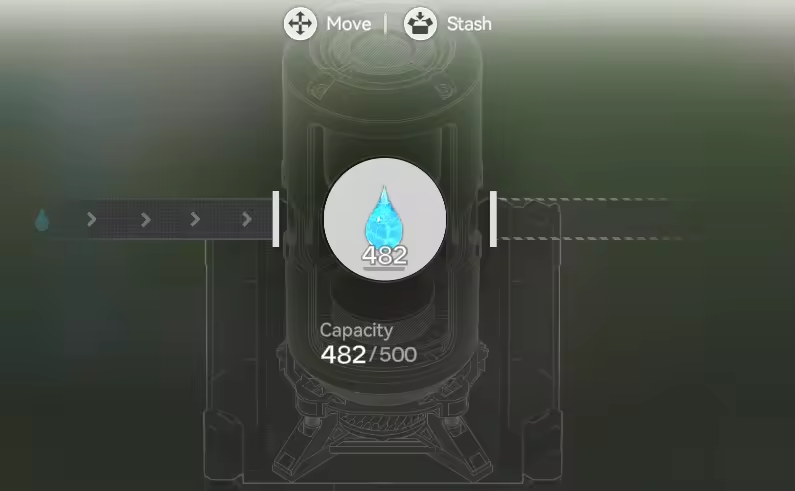
Using this method, the reflux transformer of Wuling was obtained, but this version is temporarily useless because the water intake is overflowing...
Those interested can research it themselves, after all, it's Derp Technology.
Blueprint Sharing Code: EF013Eo5i82i7auA0579